Why Your Compromised Running Pace Collapses in the Second Half
Quick Answer: The second-half collapse is usually caused by three things stacking: local muscular fatigue in the quads and glutes from the sled and lunge stations, an early pace that was too close to your fresh threshold, and a breathing pattern that never recovers after the first heavy station. Your aerobic engine is rarely the limiter. The fix is pacing the first three runs about fifteen to twenty seconds per kilometre slower than feels right, training runs immediately after heavy leg work, and practising the first ninety seconds out of every station specifically.
A race is won by the runs you did not slow down on, not the ones you ran fast early.

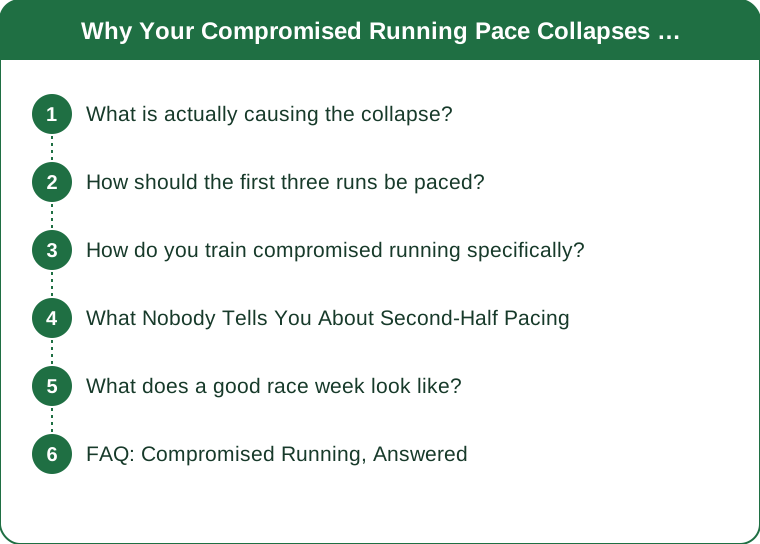
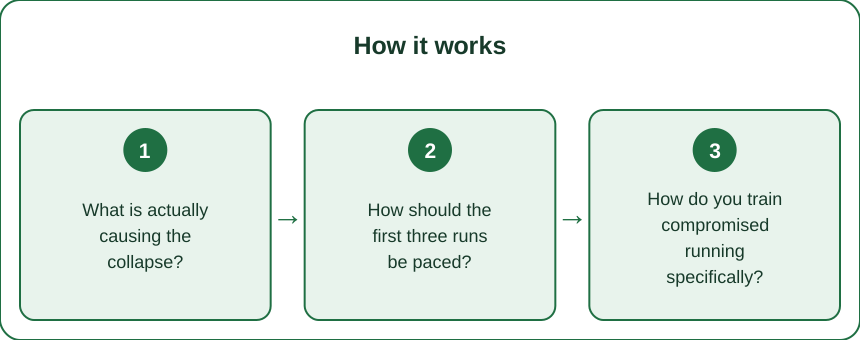
What is actually causing the collapse?
Local muscular fatigue, not central fatigue. The sled push, sled pull, lunges, and wall balls all load the quads and glutes heavily, and running relies on exactly those muscles for propulsion and shock absorption.
The specific loss is elastic return. Fatigued legs have reduced stiffness through the stance phase, so each stride costs more energy and returns less. Pace falls even at identical effort.
Then there is the pacing error. Most people run the first two runs at close to their fresh 5k pace, which is far too fast when eight kilometres and eight stations remain. The debt is paid with interest in runs five through eight.
Breathing never resets after the first heavy station. Once respiratory rate goes high and shallow, running economy suffers, and getting it back requires deliberate practice rather than hoping.
Grip fatigue affects running more than people expect - the farmers carry and sled pull leave you holding tension through the shoulders, and a tense upper body is an expensive one to run with.
And the second half is where the transitions get slow, which is separate from the running but shows up in the same split.
How should the first three runs be paced?
Fifteen to twenty seconds per kilometre slower than your fresh threshold pace is a reasonable starting target for the opening runs.
They should feel too easy. If run one feels like the right effort, it is too fast. This is the single most common error in the format and the hardest to correct because the field around you is going out fast too.
Aim for even or negative splits across the eight runs. Almost nobody achieves this; those who come close finish far better than their fitness would predict.
Know your target pace as a number, not a feeling. Feel is unreliable when your heart rate is already elevated from a station, and a watch that shows current pace is worth using.
Practise the discipline in training, because it is a discipline. Deliberately running the first intervals of a session slower than you want to is a skill.
And build in a pace band, not a single number. A five-second window per kilometre is realistic; a precise target makes you chase and surge, and surging is expensive.
How do you train compromised running specifically?
Run immediately after heavy leg work, deliberately. Not as a finisher - as the point of the session. Sled push, then a kilometre. Lunges, then a kilometre.
Keep the running volume meaningful. Short thirty-second runs between stations do not reproduce the problem. The problem appears at 600 metres, so the training run needs to be at least that far.
Practise the first ninety seconds out of a station. That is where most of the time is lost - legs are heavy, breathing is high, and cadence collapses. It is a trainable and specific window.
Use cadence as the tool. Deliberately raising cadence for the first thirty seconds out of a station shortens stride, reduces load per step, and gets you moving before your legs feel ready.
Do one session a week of pure aerobic running with no stations at all. Compromised running still needs a base, and station-heavy training alone tends to leave people without one.
And train the sled specifically for the runs after it, not just for the sled time. A sled push you survive but that ruins the next run is a net loss.

What Nobody Tells You About Second-Half Pacing
The wall balls are the run killer, not the sled. The sled hurts more in the moment; the wall balls come late, load the quads through a deep squat, and precede the final run when there is nothing left to give.
Roxzone time compounds quietly. The transitions add up to several minutes across a race, and second-half transitions are dramatically slower than first-half ones for almost everyone. That time is cheaper to save than running time.
Heart rate stops being useful information mid-race. It drifts upward and stays there, and chasing a heart rate target in the second half produces pacing decisions that are far too conservative.
Fuelling matters more than most people at this distance assume. Ninety minutes at high intensity depletes carbohydrate meaningfully, and people who take nothing in fade in a way that looks like fitness but is not.
The venue is usually hot and busy, and heat accumulates over ninety minutes in a way it does not over a 5k. Cooling opportunities - water over the head, cold sponges - are worth planning for.
And the second run feels the best of the whole race. People take that as permission to speed up. It is the moment that decides run seven.
What does a good race week look like?
Reduce volume, keep intensity. Two short sharp sessions in the final week, no long station work in the last four days.
Practise your transitions on the last hard session rather than your stations - transitions are the underpractised part and they are free time.
Rehearse the pacing plan out loud. Know your first run target, your acceptable band, and the pace you will hold in the second half regardless of how you feel at run four.
Sort fuelling in training, not on race day. Whatever you plan to take in, take it in during a hard session first.
Get the sled height and technique dialled - the sled is where the largest single time differences appear and where the worst damage to your legs happens if you do it badly.
And accept that the first three runs will feel too slow. If you finish and think you could have run the opening faster, you paced it correctly.
FAQ: Compromised Running, Answered
How much slower should my race runs be than my 5k pace?
Commonly thirty to sixty seconds per kilometre slower overall, with the opening runs closer to the fast end of that and the discipline being not to exceed it.
Why do my legs feel fine but I cannot go faster?
That is the signature of local muscular fatigue and reduced elastic return. It is not the same as feeling tired, and it responds to compromised-running training rather than to more aerobic running.
Should I do all my runs after stations?
No - keep one purely aerobic session a week. Station-heavy training without a base leaves you strong and slow.
Which station hurts my running most?
Usually the wall balls because of their placement and squat depth, with the sled push a close second because of what it does to the quads.
Is it worth training grip for running?
Indirectly, yes - grip fatigue produces upper body tension, and running tense is expensive. It also saves time on the carry and the pull.
TL;DR:
- The second-half collapse is local muscular fatigue and lost elastic return, not aerobic fitness.
- Run the opening three runs fifteen to twenty seconds per kilometre slower than feels right - they should feel too easy.
- Train runs of at least 600 metres immediately after heavy sled and lunge work, and practise the first ninety seconds out of a station.
- Raise cadence coming out of stations to shorten stride and get moving before your legs feel ready.
- Wall balls, not the sled, are the run killer - because of where they sit in the race.
Transitions in the second half are slower than the first for almost everyone, and that time is cheaper to save than running time.
Keep Reading
This article is for general informational and styling purposes only. Fit, sizing, and product availability may vary.