Why Your Wall Balls Fall Apart Before Your Legs Do
Quick Answer: Wall balls look like a squat and fail like a press. By the time you reach the last station your shoulders have already absorbed a race worth of work, and the anterior deltoid is the smallest muscle in the chain being asked to finish the movement. Add a breathing pattern that collapses under a ball held at the chest, and a target you start missing as the throw gets shorter, and you get a station that ends in ten-rep sets while your legs still feel fine.
Train the shoulders, the breath and the accuracy separately, because they fail in that order and for different reasons.

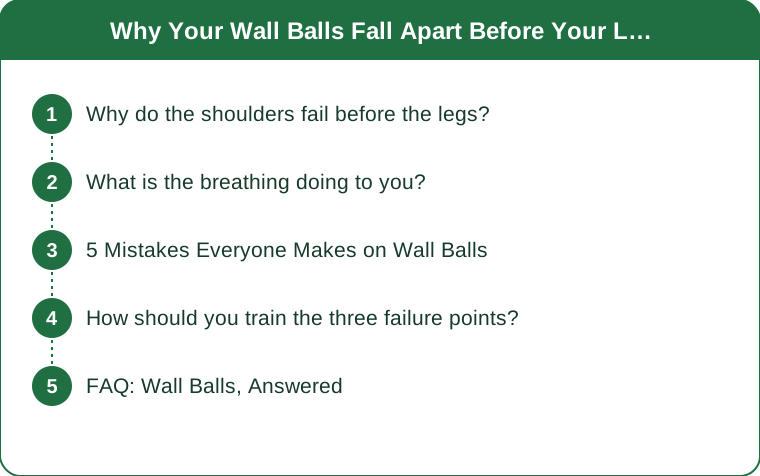
Why do the shoulders fail before the legs?
Because the leg contribution and the shoulder contribution are wildly unequal in size and in how much prior work they have absorbed.
A wall ball is a squat into a throw, and the throw is powered largely by hip and leg drive, with the shoulders finishing the trajectory. In a fresh, technically good rep, the arms do relatively little. But arms doing relatively little in a movement performed a hundred times, after a race that has already loaded the shoulders heavily, is still a large absolute amount of work for a small muscle group.
And the prior loading is the key part. By the time you reach wall balls in a Hyrox, your shoulders have done the ski erg, the sled pull, the farmers carry, the sandbag lunges and the burpee broad jumps. Every one of those loads the shoulder girdle. The legs have done a lot too, and the legs are much larger and have far more capacity.
So you arrive at the last station with fresh-ish legs and cooked shoulders, which is precisely the wrong distribution for the movement in front of you.
The failure presents in a specific sequence. First the throw gets shorter, so you start missing the target. Then you compensate by pressing more with the arms rather than driving with the legs, which accelerates the shoulder fatigue. Then the sets break down into fives and threes.
The tell that confirms it: if you could immediately do twenty air squats after failing a set of wall balls, and almost everyone could, the legs were not the limiting factor.
What is the breathing doing to you?
More than most people account for, and it is the second failure point.
Holding a nine-kilogram ball at the chest in the squat position compresses the ribcage and restricts diaphragm movement at exactly the moment you need the most air. So the catch position, which is also the lowest and most demanding position, is the one where breathing is hardest.
Most people respond by holding their breath through the catch and squat, then exhaling explosively on the throw. That works for fifteen reps and then produces a rapidly climbing carbon dioxide level and the sensation of not being able to catch up.
The pattern that works is one breath per rep, matched to the movement: exhale on the drive up and the throw, inhale during the catch and descent. It feels wrong initially because inhaling while the ball compresses your chest is uncomfortable, and it is the only way to sustain a rhythm.
The second breathing problem is the transition. Coming off burpee broad jumps into wall balls means arriving with breathing already disorganised. Twenty seconds spent standing tall and taking three deliberate full breaths before the first rep costs twenty seconds and routinely saves more than a minute across the station.
And a practical note on positioning: standing slightly further from the wall than feels natural opens the chest at the catch and makes breathing measurably easier, at a small cost in throw efficiency. For most people that trade is worth it in the second half of the station.

5 Mistakes Everyone Makes on Wall Balls
Mistake 1: Going unbroken from the start. A big first set feels like progress and produces a shoulder deficit you spend the rest of the station paying off. Planned small sets from rep one almost always produce a faster total time than a big set followed by collapse.
Mistake 2: Catching the ball high and absorbing it with the arms. Catching at the top and lowering under control with the arms is a huge additional shoulder cost. Let the ball drop and catch it late, close to the chest, absorbing with the legs as you descend into the next squat.
Mistake 3: Aiming at the target. You should be aiming above it. As fatigue reduces throw height, aiming at the line means missing within a few reps. Aiming a clear distance above it gives you a margin that fatigue eats into rather than starting from zero.
Mistake 4: Resting with the ball at the chest. Standing holding the ball to catch your breath keeps the shoulders loaded and keeps the chest compressed. Put the ball down. Every second holding it is a second of shoulder work with no reps produced.
Mistake 5: Not practising the movement fatigued. Almost everyone practises wall balls fresh, at the start of a session, in sets of twenty. Nobody’s race looks like that. The station is a test of wall balls after fifty minutes of work, and it should be trained that way. This is the mistake that most reliably separates the practice number from the race number.
How should you train the three failure points?
For the shoulders: build overhead and front-rack endurance, not strength. The limiting quality is the ability of the anterior deltoid and upper back to keep producing submaximal effort for four minutes. Front rack holds, high-rep light push presses, and sustained overhead carries all build it. Heavy pressing does not transfer well to this specific demand.
Add pre-fatigued wall ball sets. The most useful single session: ski erg or burpees to elevate the heart rate and load the shoulders, then immediately thirty wall balls. Repeat four times. This trains the exact state the race produces.
For the breath: practise the rhythm deliberately, unfatigued first. Twenty reps at an easy pace, consciously exhaling on the throw and inhaling on the catch, until the pattern is automatic. Then take it into the fatigued sets. Trying to learn a breathing pattern while already out of breath does not work.
For accuracy: practise at the end of sessions, tired. Miss rate rises sharply with fatigue and misses cost far more than they seem to, both in reps and in the mental effect. Ten minutes of tired, accurate wall balls is worth more than thirty minutes of fresh ones.
Plan the sets before the race. Decide the breakdown in advance, for example sets of fifteen with five-second breaks, and hold it from rep one. The most common race error is improvising the set structure while oxygen-deprived.
And practise picking the ball back up. The transitions between sets are where the time goes, and a fast, controlled pick-up with a good first rep is a trainable skill that nobody trains.
One caveat: shoulder pain rather than fatigue is a different signal. Sharp pain, pain at the front of the shoulder that persists, or pain that changes your movement warrants assessment rather than more volume. This is general information, not medical advice.
FAQ: Wall Balls, Answered
How should I break up 100 wall balls?
Most people do best with planned sets of ten to twenty with short breaks, held consistently. Big early sets followed by singles is almost always slower.
Should I catch the ball or let it drop?
Let it drop and catch late, close to the chest. Catching high and lowering under control is a large hidden shoulder cost.
Why do I miss the target when I get tired?
Throw height falls with fatigue. Aim well above the target from the start so fatigue eats into a margin rather than into your rep count.
Is a heavier ball useful in training?
Occasionally, for short sets. The specific demand is endurance at race weight, so most of your volume should be at race weight.
How do I stop my breathing falling apart?
One breath per rep: exhale on the throw, inhale on the catch. Learn it fresh before trying to use it fatigued.
My legs feel fine and I still fail. Is that normal?
Completely. It is the standard presentation, and it means your training should target shoulders, breath and accuracy rather than more squatting.
TL;DR:
- Wall balls fail at the shoulders because your shoulders arrive at the last station having done every previous one.
- The catch position compresses the ribcage, so breathing is hardest exactly when you need it most.
- One breath per rep, exhale on the throw and inhale on the catch, sustains the rhythm.
- Plan your sets from rep one; a big first set produces a deficit you pay off for four minutes.
- Let the ball drop and catch late, aim well above the target, and put the ball down when you rest.
- Train wall balls pre-fatigued, because a fresh practice number tells you nothing about race day.
If you could do twenty air squats immediately after failing, it was never your legs.
Keep Reading
This article is for general informational and styling purposes only. Fit, sizing, and product availability may vary.