The Pacing Mistake Almost Every First-Time Hyrox Racer Makes on the Running Segments
Quick Answer: Almost every first-time Hyrox racer runs the early 1 km segments too fast, because those runs feel easy compared to the station that just ended. Adrenaline hides the cost. The fix is deliberately running early segments slower than comfortable, training race pace under fatigue, and targeting a negative split.
You come off the ski erg, hit the running track, and it feels almost like relief. Your legs turn over easily. You think: this is fine, I’ve got room here.
That feeling is the single most expensive lie in the race, and it collects around station five.

Why Do the Early Hyrox Runs Feel So Easy?
Two things are happening, and neither one is a signal about your actual capacity.
Contrast effect. You’ve just finished a demanding functional station. Relative to that, running feels light. Your perception is calibrated against the last 4 minutes rather than against the remaining hour, and perception is a terrible judge of sustainability when the reference point keeps changing.
First-race adrenaline. Race day masks accumulating physiological cost. The effort registers as lower than it is, exactly when you’re making pacing decisions you’ll live with for another seven stations.
Put those together and you get a runner whose felt effort says “comfortable” while their actual output says “unsustainable across eight stations.” The feeling isn’t lying about the present moment. It’s lying about the future.
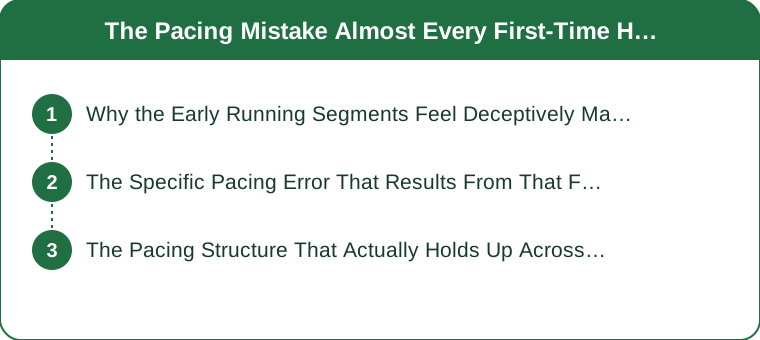
What’s the Specific Pacing Error?
Running the early segments at or faster than a standalone comfortable running pace.
That framing matters. First-timers aren’t sprinting. They’re running at something that would genuinely be sustainable for a plain 8 km run — and that’s the mistake, because this isn’t a plain 8 km run. It’s 8 km interleaved with eight functional stations that will progressively drain the legs doing the running.
Your sustainable pace here has to account for work you haven’t done yet. Almost nobody does that arithmetic on race day.
The cost is deferred, which is why it keeps happening. Stations one through four feel fine. It’s around the back half — often the sled push and the burpee broad jumps, when accumulated fatigue lands all at once — that the bill arrives. By then there’s no recovering the time; you’re just managing damage.
The cruelty of the format is that the mistake gives you no feedback until it’s too late to correct.

5 Mistakes Everyone Makes in Their First Hyrox
- Pacing off feel instead of a plan. Feel is compromised by contrast and adrenaline. Bring numbers.
- Racing the person next to you in segment one. You have no idea what division they’re in or how their day ends.
- Training runs and stations separately. Fresh running speed tells you almost nothing about running speed after a sled push.
- Sprinting the transitions. Transitions look like free time. They’re where a lot of first-timers spike their heart rate for no useful gain.
- Treating the first run as the benchmark for the rest. The third mistake surprises even fit racers, but this one causes the most damage — it locks in a pace set at your freshest possible moment.
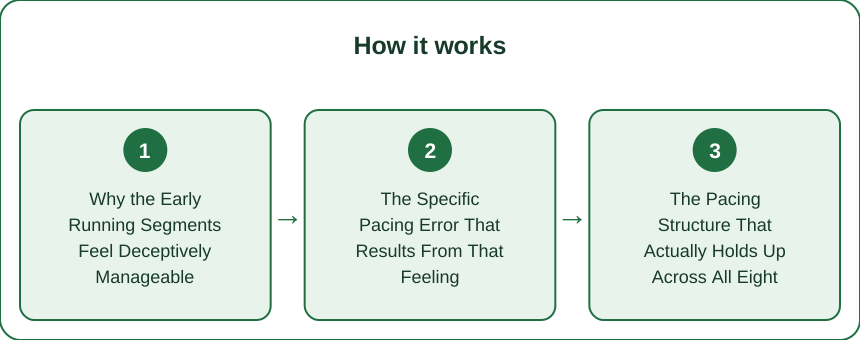
What Pacing Structure Actually Holds Up?
Run the early segments slower than what feels comfortable. Deliberately. You already know the comfortable feeling is distorted, so treat it as unreliable data rather than as your guide. If segment one feels genuinely easy and slightly frustrating, that’s roughly correct.
Train your race pace under fatigue, not fresh. In practice: run your 1 km intervals after a station-style effort, not before. Do a sled push or a set of wall balls, then run, and record that pace. That number is your real race pace. Your fresh 1 km time is a different, mostly irrelevant number.
Target a negative split explicitly. Aim to run the second half slightly faster than the first. Most first-timers accept a big late-race slowdown as inherent to the format — it isn’t. It’s the signature of a front-loaded pace. If your last run is your fastest, you paced it right.
Practical execution: know your target pace per kilometre before the race, check it in the first 200 m of segment one, and correct immediately if you’re under it. That single early check prevents most of the damage, because the first segment sets the anchor for everything after.
A small thing that isn’t small on race day: wear kit you’ve already trained in. Eight stations of transitions, floor work, and burpees is a bad time to discover a waistband rolls. Fitted squat-proof high waist leggings with a secure waistband are worth more here than they sound.
FAQ
What pace should I actually target for my first Hyrox?
Rather than a universal number, use your own fatigued 1 km pace from training — run intervals after station work and use that time, then plan to run the first segment slightly slower than it.
Should I walk any of the running segments?
A planned brief walk through transitions is often smarter than an unplanned collapse at station six. Walking because you blew up is the failure mode; walking as strategy is fine.
How much slower should the first run feel?
Slow enough that it feels genuinely conservative and a little annoying. If segment one feels like a good honest effort, it’s too fast.
TL;DR
- Early runs feel easy because of contrast with the station before and race-day adrenaline — not because you have room.
- The error is running early segments at standalone comfortable pace, ignoring the fatigue seven more stations will add.
- The cost appears in the back half, too late to fix.
- Fix it by running early segments deliberately slower, training pace under simulated fatigue, and targeting a negative split.
Keep Reading
This article is for general informational and styling purposes only. Fit, sizing, and product availability may vary.