Hyrox Sandbag Lunges: Why the Slow Station Ends So Many Races
Quick Answer: The sandbag lunge fails on two things — where the bag sits and how long each rep takes. A bag riding high on the neck pulls you forward and turns every rep into a quad-only grind; a bag settled low across the shoulder blades keeps you upright and lets your glutes work. Then pace it by rhythm, not by effort: a steady, unbroken cadence with no rest beats fast segments with three breaks, almost every time.
This is general information, not medical advice.

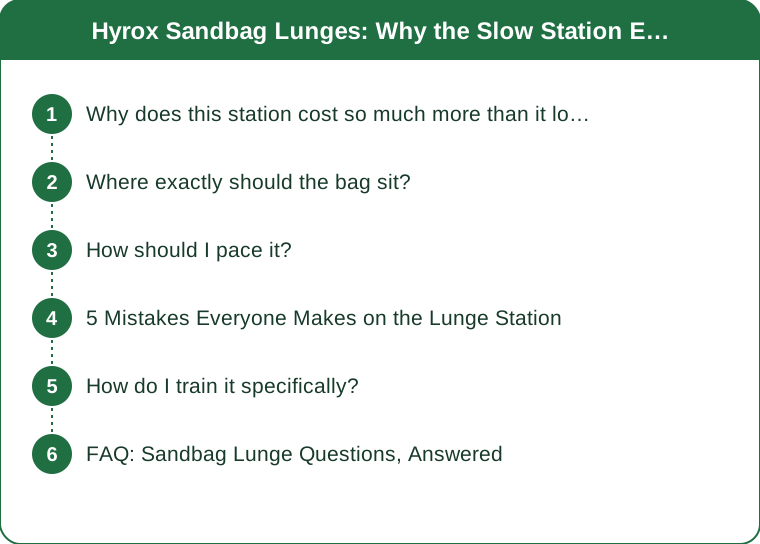
Why does this station cost so much more than it looks like it should?
It comes late, after everything has already been emptied. By the time you reach it, your legs have been through the sled push, the sled pull, the row and several kilometres of running. The station is not hard in isolation; it is hard eighth.
Lunges load one leg at a time under fatigue. Bilateral work distributes; unilateral work does not. Every rep is a single-leg strength demand at a point where single-leg strength is the first thing to have gone.
The bag changes your centre of mass. Load sitting above and behind your shoulders shifts your balance point backwards and upwards, which increases the stabilising demand at every single step.
The distance is longer than it feels. It reads as a short walk and it is a substantial number of reps, and people who have not counted them in training are consistently surprised.
And there is no rhythm to hide in. Running and rowing both have a cadence that carries you. Lunges do not — every rep is a separate decision, which is a psychological cost as well as a physical one.
Where exactly should the bag sit?
Across the top of the shoulder blades, not on the neck. The bag should rest on the shelf of muscle behind your shoulders with your traps engaged, roughly where a low-bar squat sits, and the difference in how your back feels after twenty reps is dramatic.
Hold it in place with your hands high on the sides of the bag, elbows forward and down rather than flared. Elbows out lets the bag roll upward toward your neck with every step.
Squeeze it against you. A bag that moves independently of your torso is a bag that pulls you off balance twice per rep, and the energy cost of correcting that adds up quickly across the station.
Reset early rather than late. If the bag has crept up onto your neck, stopping for two seconds to reposition costs less than the twenty reps you would otherwise do in a compromised position.
Practise the pickup and the reset in training. People train the lunges and never train getting the bag onto their back when they are already exhausted, which is where a surprising amount of race-day time disappears.
And test both bag types. Different events and different gyms use different bag constructions, and a stiff bag behaves nothing like a soft one across your back.
How should I pace it?
Set a cadence at the start and defend it. A consistent rhythm from the first rep, slower than you think you need, produces a better station time than starting fast and breaking.
Count in blocks rather than total reps. Breaking the distance into segments you tick off is far more manageable than facing the whole thing as one number.
Breathe on a fixed pattern. One breath per rep, tied to the step, stops the shallow panic breathing that makes the last third feel unsurvivable.
Do not stand up fully between reps. Standing tall resets your hip position and costs both time and energy. Stay in the movement.
Accept that the first hundred metres afterwards will be bad. Everybody’s running is compromised straight off the lunges; the people who look composed have simply planned for it rather than being surprised by it.
And know your realistic time for it. Going into the station without an intended pace means pacing it by feel, and feel is unreliable at that point in the race.

5 Mistakes Everyone Makes on the Lunge Station
Letting the bag ride up onto the neck and never resetting it. This turns a hip-and-glute movement into a quad-and-lower-back movement, and it is the single most common cause of both slow times and next-day back soreness.
Taking huge steps. A long stride feels efficient and is not. Shorter steps mean less time under load per rep, less balance demand, and a knee that tracks over the foot rather than beyond it.
Resting standing up with the bag on. If you need a break, the bag comes off. Standing under load recovering nothing while the clock runs is the worst of both options.
Never training it under fatigue. Fresh lunges tell you almost nothing about race lunges. The station has to be practised after a run and a sled, not at the start of a session.
Going out at a cadence you can hold for a third of the distance. The fourth mistake surprises even experienced athletes, because the station rewards patience more obviously than any other and punishes enthusiasm within about ninety seconds.
And the bonus mistake: looking at the floor. Eyes down rounds the upper back, which encourages the bag forward, which loads the quads further. Look at a point on the wall ahead.
How do I train it specifically?
Train the exact distance, not a generic lunge workout. Knowing precisely how the full station feels removes the largest unknown on race day.
Do it after running. Twenty minutes of running into the full lunge distance is the single most valuable session for this station, and it is uncomfortable enough that most people avoid it.
Build single-leg strength separately. Rear-foot elevated split squats, three sets of eight per leg with ninety seconds rest, twice a week, build the base that lets you hold position under fatigue.
Train the upper back too. Rows, carries and face pulls build the capacity to hold a bag in position for several minutes, and upper back fatigue is why the bag creeps upward late in the station.
Practise with the bag weight you will race with, not a lighter one. The technique that works at a lighter weight does not always transfer.
Include a weekly session on tired legs deliberately. Fatigue-resistance is trainable and is largely what separates a good lunge station from a bad one.
And do at least one full-distance attempt every training block so your pacing plan is based on data rather than hope.
FAQ: Sandbag Lunge Questions, Answered
Should my knee touch the floor every rep?
Check the standard for your event and train to it, because a rep that does not count is worse than a slow one. Practising to the exact standard removes any judgement calls under fatigue.
Is it better to go faster and break, or slower and continuous?
Slower and continuous, in almost every case. Breaks cost more than the pace difference gains, and restarting under a bag is expensive.
Why is my lower back the sore part the next day?
Almost always bag position. A bag riding high tips you forward and your lower back holds the position your glutes should be holding.
TL;DR:
- The station is hard because of when it comes, not what it is.
- Bag across the shoulder blades, elbows forward, squeezed tight — never on the neck.
- Short steps, fixed cadence, one breath per rep, no standing rest under load.
- Train the full distance after running, with race weight, at least once per block.
- Build single-leg strength and upper back capacity separately.
The slow station is where patience beats fitness.
Keep Reading
This article is for general informational and styling purposes only. Fit, sizing, and product availability may vary.