Why Your Hyrox Time Falls Apart on the Runs (Not the Stations)
Quick Answer: Most Hyrox time loss happens on the 8x1K runs between stations, not the stations themselves — legs pre-fatigued from sled pushes and lunges turn what should be an easy pace into a shuffle. Practice running specifically on fatigued legs, not just running fresh and stations separately.
You trained the sled push. You trained wall balls until your shoulders burned. Race day, the stations went fine — and your run splits still fell apart by station 5. That’s the single most common Hyrox pacing mistake, and it’s not really about station strength at all.

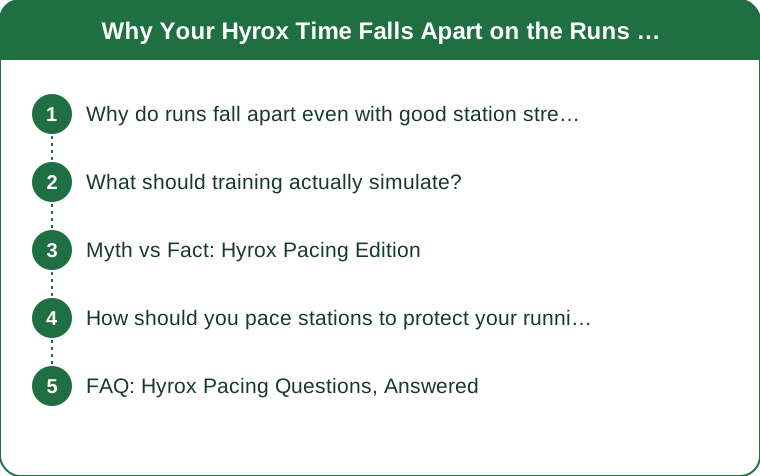
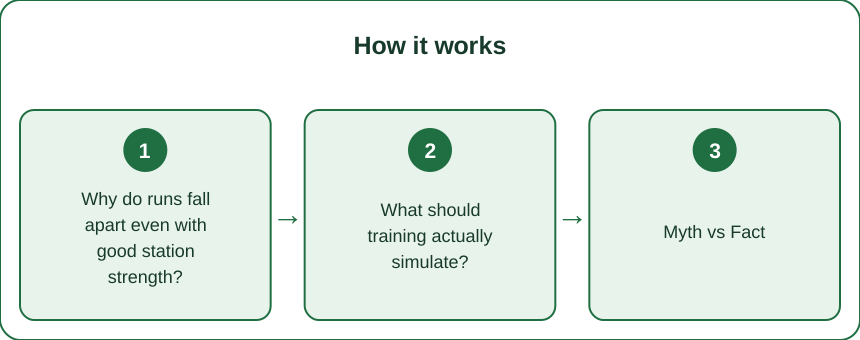
Why do runs fall apart even with good station strength?
Because running on legs pre-fatigued from sled work, lunges, and burpee broad jumps is a completely different skill than running fresh. Most training plans practice stations and running separately, so athletes never actually rehearse the specific sensation of running on compromised legs — race day is the first time they encounter it.
What should training actually simulate?
Compromised running — run intervals immediately after leg-fatiguing work (sled pushes, lunges), not as a separate session days apart. Even a simple drill (sled push, then immediately run 400-800m at goal race pace) trains the specific adaptation Hyrox demands, which pure running or pure strength training alone doesn’t.

Myth vs Fact: Hyrox Pacing Edition
Myth: If you’re a strong runner, the Hyrox runs will be easy. Fact: Open 10K pace means little when your legs are pre-fatigued from four stations — compromised-running training is a distinct skill from open running fitness.
Myth: Going all-out on stations and recovering on the run is fine. Fact: Blowing up a station and trying to ‘recover’ during the run usually produces the opposite — the run becomes the recovery cost you didn’t budget for.
Myth: The sled is always the hardest part. Fact: For most first-timers, the run splits degrade more dramatically than any single station — the sled just gets blamed because it’s felt directly.
How should you pace stations to protect your running?
Slightly conservative effort on stations 1-4, saving a true maximal push for the back half once you know your running legs are holding. Athletes who negative-split their runs (later runs faster or equal to early ones) consistently post better overall times than those who go all-out early and watch their run pace decay.
FAQ: Hyrox Pacing Questions, Answered
How much should I hold back on stations to protect my run?
Aim for roughly 80-85% effort on the first 2-3 stations, saving your hardest push for stations you’re strongest at, later in the race.
Should compromised-running practice happen every training session?
Once or twice a week is enough to build the adaptation without overloading recovery — don’t replace all your regular running and strength work with it.
Is it normal for run splits to slow through a Hyrox race?
Some slowdown is normal, but a dramatic collapse (30+ seconds per km slower by the final runs) usually signals overpacing stations early, not a fitness gap.
TL;DR:
- Run splits, not station performance, are where most Hyrox time gets lost
- Train compromised running — running immediately after fatiguing leg work — not stations and runs separately
- Pace stations 1-4 slightly conservative to protect your run splits
- A dramatic run slowdown late in the race usually means overpacing early stations, not weak fitness
Keep Reading
This article is for general informational and styling purposes only. Fit, sizing, and product availability may vary.