How to Pace Wall Balls Without Ruining the Last Run
Quick Answer: Break the 100 wall balls into planned sets from the very first rep — commonly 20-20-15-15-10-10-10 or 10 sets of 10 — with rest intervals of 10 to 15 seconds. The rep count is not what breaks people; the failure to plan the breaks is. Going unbroken until failure produces a longer total time and a substantially worse final run than a broken plan does.
Decide your sets before the race. In the moment, after seven kilometres of running, you will not make a good decision about it.

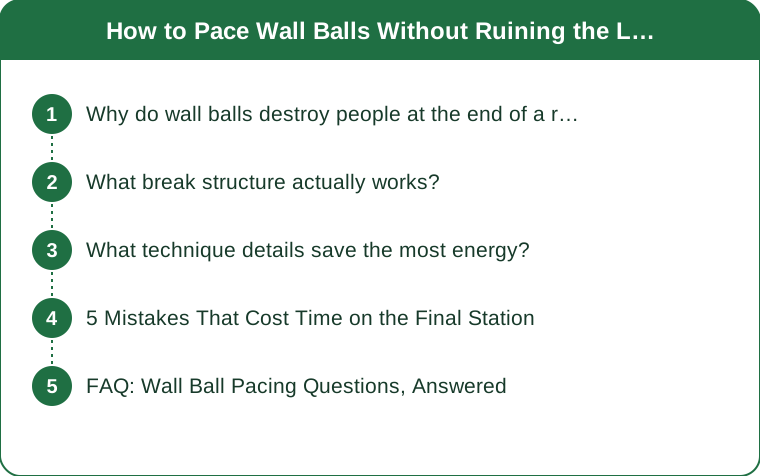
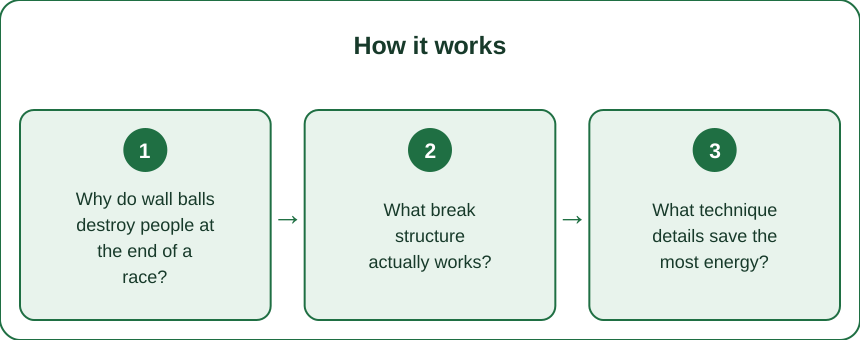
Why do wall balls destroy people at the end of a race?
Because they combine three demands that are already depleted.
Legs. A wall ball is a full squat, and you arrive having run 8km and pushed and pulled a sled. The quads are already accumulating fatigue, and 100 squats is a substantial additional volume.
Shoulders and arms. The throw is an overhead push, and the burpee broad jumps, farmers carry and sandbag lunges that preceded it have all loaded the upper body. Shoulder fatigue is what makes the throw fall short of the target, which is what produces no-reps.
Breathing. The movement compresses the torso at the bottom of the squat and demands a forceful exhale at the top, all at a heart rate already near threshold. Many people find breathing, not muscular fatigue, is what actually forces the break.
And the specific trap: it is the last station. The finish line is visible, and the temptation to just get through it is overwhelming. That is exactly the mindset that produces a set of 40, a total collapse, and then five minutes of two-rep sets.
The math is brutal on this. Someone who does 40 unbroken and then grinds out the remaining 60 in small sets almost always takes longer than someone who does disciplined sets of 10 the whole way, and finishes far more depleted for the final run.
What break structure actually works?
One that starts breaking before you need to, and stays consistent.
The principle: plan short, consistent sets with short, consistent rests. The rest should be measured in breaths, not in how you feel.
Three structures that work, depending on capacity:
- 10 sets of 10, resting 10 seconds. The most reliable structure for most first-timers. Predictable, sustainable, and mentally simple — ten blocks, count down.
- 20-20-15-15-10-10-10. Front-loaded, taking advantage of relatively fresher legs early. Works if you have tested it in training.
- 5 sets of 20 with 20-second rests for stronger athletes with a real wall ball base.
The rest rule that matters most: put the ball down, take three to four deep breaths, pick it up. Not more. Rests that stretch past about 15 seconds start costing more time than the fatigue they relieve.
Count your breaths rather than watching a clock. You will not reliably read a watch at that heart rate, and three deep breaths is a consistent measure that scales with how hard you are working.
Choose the structure in training and do not change it on race day. The single most common race-day error is starting with a plan and abandoning it in the first 30 reps because you feel good. You feel good because you have done 20 reps.

What technique details save the most energy?
Four, and the first one is worth more than the rest combined.
1. Use the legs to throw, not the arms. The ball should be launched by the extension of the hips and knees, with the arms guiding rather than pressing. If your shoulders are burning, you are pressing the ball rather than throwing it, and you will run out of shoulders long before you run out of legs.
2. Catch high and absorb into the squat. Receiving the ball at chest height with elbows in, then descending in one motion, uses the eccentric loading to feed the next rep. Catching low and re-setting adds a full extra movement every rep, which over 100 reps is enormous.
3. Keep the elbows in and the ball close. Elbows flaring out puts the load on the front delts and requires more force to produce the same throw height. Ball resting against the chest, elbows tucked.
4. Consistent target aim. Missing the target high wastes energy; missing low is a no-rep. Pick a specific spot on the target and hit it every time. In training, do sets while deliberately watching where the ball lands to calibrate.
On the squat depth: the standard requires hip crease below the knee. Practicing at exactly the required depth, not deeper, saves meaningful energy across 100 reps — but practice it precisely, because judging depth under fatigue is where no-reps happen.
And breathing: exhale on the throw, inhale on the descent. Holding the breath through multiple reps at that heart rate is what forces most unplanned breaks.
5 Mistakes That Cost Time on the Final Station
1. Going unbroken until failure. The single most expensive error. Hitting muscular failure means the recovery takes minutes rather than seconds, and the sets afterwards get progressively smaller.
2. Resting too long between sets. Once the rest exceeds about 15 seconds, heart rate drops but total time balloons. Ten seconds, three breaths, back on the ball.
3. Ignoring the roxzone before the station. Arriving at wall balls at maximum heart rate because you sprinted the last transition means the first set is compromised. The 200m before wall balls is where you should settle your breathing deliberately.
4. Not practicing wall balls under fatigue. Doing 100 wall balls fresh in training tells you very little. Practice them after a hard run at race intensity, which is a completely different exercise and the only honest test of your break structure.
5. Forgetting there is still a run afterwards. The final 1km run comes after wall balls, and how you finish this station determines that run. Emptying the tank on rep 90 costs more on the run than it saves on the station.
FAQ: Wall Ball Pacing Questions, Answered
How should I train the break structure?
Do 100 wall balls after a 1km run at race pace, using your intended structure exactly. Once every two to three weeks in the last eight weeks before a race. That session tells you more about your race than any other single workout.
What if I no-rep repeatedly?
Slow down and hit depth and target deliberately for a few reps to recalibrate. No-reps are almost always caused by fatigue-driven depth loss or a shoulder-driven throw that falls short. Continuing at the same pace and hoping is expensive.
Should I use a different weight in training?
Train at race weight for the specific work, and use a lighter ball occasionally for high-volume technique practice. Training exclusively heavier is not particularly useful for a station that is fundamentally about endurance and technique consistency.
How much does grip matter here?
More than people expect, since the ball is held against the chest with tired hands after the farmers carry. If grip is failing, check that you are supporting the ball on the forearms and chest rather than gripping the surface, which is a common and correctable error.
TL;DR:
- Plan your break structure before the race — 10 sets of 10 with 10-second rests is the reliable default.
- Rest by counting three to four breaths, never by feel, and never past about 15 seconds.
- Throw with the legs; if your shoulders burn, you are pressing rather than throwing.
- Catch high and absorb into the next rep instead of resetting each time.
- Practice 100 wall balls after a hard run, not fresh — it is the only honest test.
- Remember the final 1km comes after this. Do not empty the tank on rep 90.
The reps are not what breaks people. The absence of a plan is.
Keep Reading
This article is for general informational and styling purposes only. Fit, sizing, and product availability may vary.