The Hyrox Station Everyone Underestimates Until Race Day
Quick Answer: The farmers carry is the most consistently underestimated Hyrox station — it looks simple on paper, but grip fatigue compounded by pre-fatigued legs from the preceding run and stations makes it far harder in a race than it ever feels in isolated training.
Everyone trains hard for the sled push and dreads the wall balls. Meanwhile, the farmers carry — 200m of just walking while holding weight — quietly wrecks more first-timers’ race times than either of those stations, and almost nobody sees it coming.

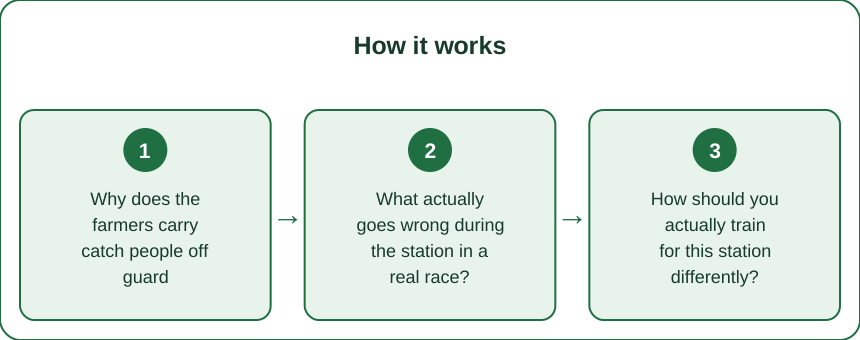
Why does the farmers carry catch people off guard specifically?
Because in isolated training, a 200m farmers carry with race-weight kettlebells feels genuinely manageable — most people can complete it without much grip strain when it’s the only thing they’re doing that day. The problem is Hyrox’s format: the farmers carry comes after a full run and several prior stations, so your grip, core, and legs are already fatigued before you pick the weights up. Grip strength specifically fatigues faster than most other muscle groups under sustained load, and a grip that felt strong in an isolated test can fail well before 200m when it’s already been taxed by everything before it.
What actually goes wrong during the station in a real race?
The most common failure pattern is unplanned stops — putting the weights down to shake out your hands, which costs far more time than most racers expect, both from the stopped movement and from re-establishing pace afterward. A grip that fails at 120m and requires 3 separate stops to finish the remaining 80m routinely costs 45-90 seconds compared to an unbroken carry, which is often more time lost than a poorly-paced sled push or a slow set of wall balls.
How should you actually train for this station differently?
Train it fatigued, not fresh. Doing farmers carries as your first exercise of a session tests a capacity you won’t actually need on race day. Instead, place carry practice after a run and at least one other fatiguing exercise, mimicking the actual race sequence — this trains the specific fatigued-grip capacity that isolated fresh-state training never touches.
Grip-specific accessory work (dead hangs, farmer carry holds for time rather than distance) also builds raw grip endurance that transfers directly, and it’s a station most training plans skip because it doesn’t look impressive compared to sled or burpee work.

Does pacing strategy change for this station specifically?
Yes — most other Hyrox stations reward pushing hard because the movement itself is the limiter. The farmers carry rewards a slightly conservative, unbroken pace over an aggressive one that risks a mid-carry grip failure. A steady pace you can sustain without stopping consistently beats a faster pace that breaks down into multiple stops, even though the broken approach might look faster in short bursts.
What Nobody Tells You About Grip Fatigue in Hyrox
Grip fatigue from the farmers carry doesn’t stay contained to that station — a blown-out grip affects your ability to firmly hold the sled push handles and control the wall ball catch in whatever station comes right after, creating a compounding effect that well-prepared racers specifically train to avoid. This is why experienced Hyrox athletes treat grip endurance as a race-long resource to manage, not a single-station skill.
FAQ: Hyrox Farmers Carry Questions, Answered
What weight should I train farmers carries at for Hyrox?
Match race-standard weight (check current official weights for your division) and prioritize unbroken distance capacity over heavier weight with frequent stops.
How do I build grip endurance specifically for Hyrox?
Dead hangs, farmer carry holds for time, and — most importantly — practicing carries in a fatigued state after a run or other station, not just fresh.
Is it better to go fast or steady on the farmers carry station?
Steady and unbroken almost always beats fast-with-stops — the time lost to grip failure and restarting typically exceeds any time gained from an aggressive initial pace.
TL;DR:
- Farmers carry looks simple but compounds with pre-fatigued grip from earlier stations — it’s the most underestimated station
- Unplanned stops from grip failure can cost 45-90 seconds versus an unbroken carry
- Train it fatigued (after a run or other exercise), not fresh, to build race-realistic grip capacity
- A steady unbroken pace beats an aggressive pace that risks mid-carry stops
The station that looks like a rest between harder exercises is often the one quietly deciding your race time.
Keep Reading
This article is for general informational and styling purposes only. Fit, sizing, and product availability may vary.