Why Your Heart Rate Spikes Wildly Different on Each Hyrox Station — Even at the Same Effort
Quick Answer: Heart rate spikes vary by station because Hyrox mixes strength-dominant stations (sled push, farmers carry) that rely more on local muscular fatigue with cardio-dominant stations (running, burpee broad jumps) that drive heart rate up systemically — the same subjective effort produces very different heart rate numbers depending on which system is being taxed. Pacing by station type, not a single flat heart rate target, is what actually works.
Your heart rate reads 165 during the ski erg and 178 during burpee broad jumps at what feels like the same 8/10 effort. That’s not inconsistent pacing — it’s two different physiological systems being loaded.

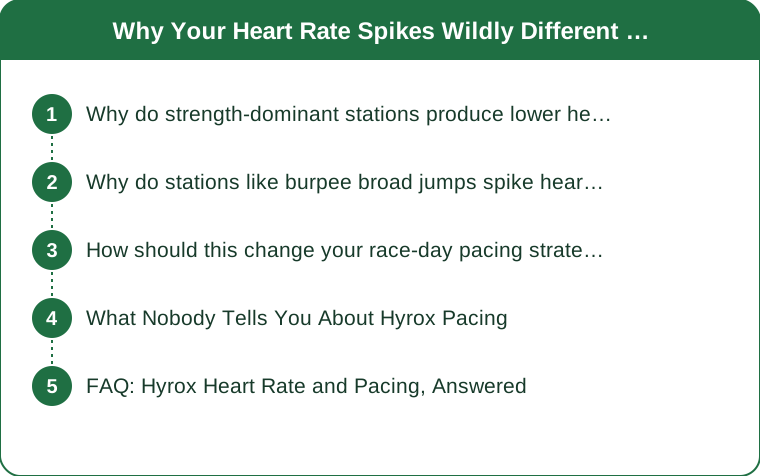
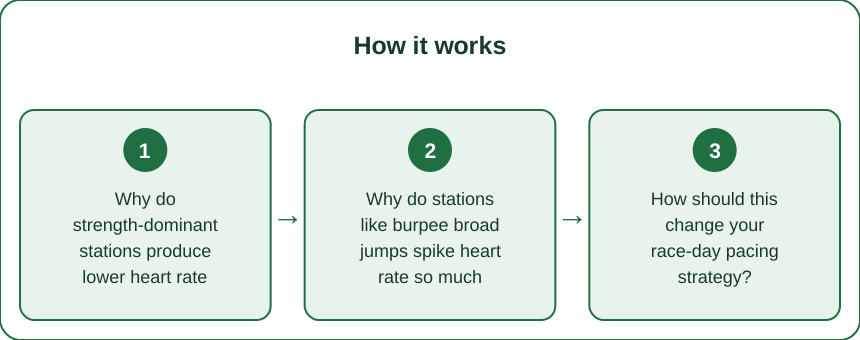
Why do strength-dominant stations produce lower heart rate at the same perceived effort?
Stations like the sled push and farmers carry rely heavily on local muscular fatigue — your legs or grip give out before your cardiovascular system is maximally taxed, so heart rate lags behind how hard the station actually feels. The limiting factor is muscle, not lung capacity or cardiac output.
This is why you can finish a sled push breathing relatively normally but with legs that feel completely spent — the systems fatigue on different timelines.
Why do stations like burpee broad jumps spike heart rate so much faster?
Full-body, high-frequency movements recruit large muscle groups repeatedly in a short time, driving heart rate up systemically rather than fatiguing one local muscle group first. This is a cardiovascular-dominant demand, which is why heart rate at burpee broad jumps or the final run often outpaces how ‘hard’ the movement itself feels compared to something like the sled.
Understanding which category each station falls into helps explain why a flat perceived-effort target across all eight stations doesn’t actually produce even pacing.

How should this change your race-day pacing strategy?
Treat strength-dominant stations as controlled-effort, not all-out — since local muscle fatigue is the limiter there, going too hard early just steals capacity from the run that follows. On cardio-dominant stations and runs, pace by heart rate zone rather than by how the movement feels, since perceived effort tends to underestimate true cardiovascular strain there.
Many athletes’ Hyrox times fall apart specifically because they under-paced sled work (thinking it wasn’t taxing their heart) and then had nothing left for the runs that followed.
What Nobody Tells You About Hyrox Pacing
Nobody tells you that the run segments, not the stations themselves, are usually where race times are actually won or lost — because station-specific muscular fatigue compounds across all eight runs even when heart rate looks fine between them. A runner who paces sled and farmers carry conservatively often posts a faster overall time than one who goes all-out early and drags through the final two runs.
The stations that feel hardest in the moment aren’t always the ones costing you the most time by race’s end.
FAQ: Hyrox Heart Rate and Pacing, Answered
Should I wear a heart rate monitor during a Hyrox race?
It’s genuinely useful for pacing the runs and cardio-dominant stations, though less critical for strength stations where muscular fatigue is the real limiter.
Why does my heart rate stay elevated between stations even when resting?
The roxzone transition periods are short, and residual cardiovascular strain from the previous station often doesn’t fully settle before the next one starts — this is expected and part of race demand.
Is it bad if my heart rate hits max during burpee broad jumps?
Not inherently — that’s a cardio-dominant station where high heart rate is expected; the concern is more about whether you can recover enough before the following run.
TL;DR:
- Strength-dominant stations (sled, farmers carry) fatigue muscle before heart rate maxes out
- Cardio-dominant stations (burpee broad jumps, runs) drive heart rate up faster than perceived effort suggests
- Pace strength stations conservatively to protect the runs that follow
- Race times are often won or lost in the runs, not the stations that feel hardest in the moment
Understanding which system each station taxes turns a flat all-out strategy into a real pacing plan — and that’s usually worth more than any single station-specific technique fix.
Keep Reading
This article is for general informational and styling purposes only. Fit, sizing, and product availability may vary.