Why Your Training Splits Never Match Your Race Day Times
Quick Answer: Race splits run slower than training splits because training almost never replicates the accumulated fatigue, the transitions, the crowding and the equipment differences of race day. The largest single contributor is that gym sessions test stations in isolation while the race tests them after a run, in a queue, on a different surface. Expect a gap of roughly 10 to 25 percent on station times, and build training that closes it rather than training that flatters you.
Your sled time in the gym: 3:10. On race day: 4:40.
Same distance, same weight, allegedly.
Here is where the ninety seconds actually went.

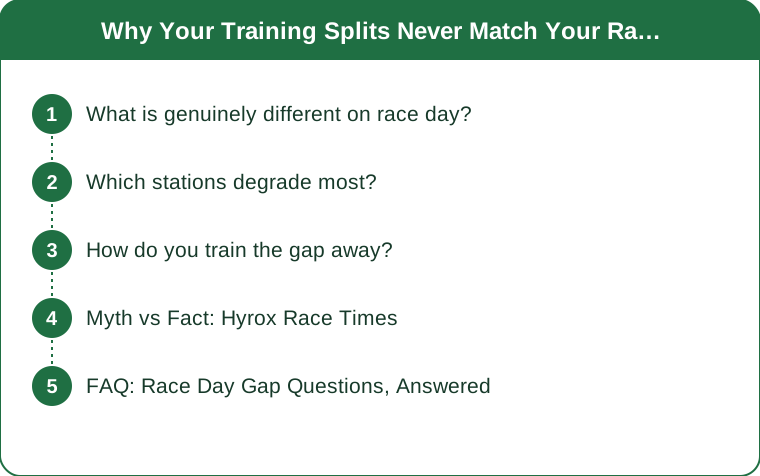
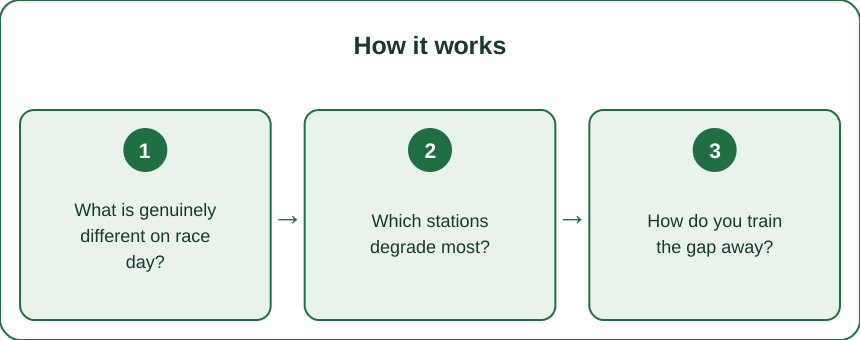
What is genuinely different on race day?
Six things, and they compound rather than add.
You arrive at every station already fatigued. In training, most people do a sled and rest. In the race, every station follows a kilometre of running, and every run follows a station. The physiological state you enter each station in is nothing like the state you tested it in.
Flooring and equipment differ. Sled friction varies enormously with surface — carpet type, how recently it was laid, how many athletes have already dragged across it. The same nominal weight can feel dramatically different. Rowers, ski ergs and wall ball targets also vary in setup and calibration.
The roxzone is real time you never practise. The distance between the run and the station, plus finding equipment and getting set, adds up across eight transitions. Many athletes lose several minutes here without ever having trained it.
Crowding changes your pace. Congestion in the run corridors, waiting for a lane, and navigating around other athletes all cost time and disrupt rhythm, particularly in the first half.
Adrenaline distorts pacing. Almost everybody runs the first kilometre faster than planned, which is a decision that gets paid for at station six onwards.
Grip fatigue accumulates across the whole race. Farmers carry, sled pull, sandbag lunges and the ski erg all draw on the same forearms, and unlike in training, they arrive in sequence with no recovery between them.
Which stations degrade most?
The pattern is consistent enough to plan around.
The runs degrade most in absolute terms. Total run time is the largest block of the race, and the difference between a fresh kilometre and the seventh kilometre after a sled push is enormous. Athletes routinely lose more time across the runs than across all the stations combined.
The sled push and pull suffer from surface variation. These are the stations where the gym-to-race gap is widest, because friction is the dominant variable and you cannot replicate an unfamiliar carpet.
Wall balls collapse at the end. As the final station arriving on completely spent legs, wall ball times commonly run far beyond what the same athlete produces fresh. Everybody knows this and most people still pace as if it will not happen.
Grip-limited stations degrade later than expected. Farmers carry often feels fine in training and becomes a problem in the race specifically because of what preceded it.
The rower is where fitness shows honestly. It is the station with the least equipment variability, which means a large gap here is usually a genuine pacing or fitness issue rather than a race-condition one.
Burpee broad jumps punish poor pacing more than poor fitness. Athletes who went out hard find this station is where the race gets decided against them, and the degradation is steep rather than gradual.

How do you train the gap away?
By making training more like the race, which mostly means less rest and more sequencing.
Always pair a run with a station. The single highest-value change. Never test a station fresh if you want a number that means anything — run a kilometre first, every time.
Practise compromised running specifically. Run 400 to 1000 metres immediately after a heavy station, repeatedly. The skill of finding your running rhythm on trashed legs is trainable and it is where most of the race is won.
Time your transitions and train them. Deliberately practise moving from station to run with the same urgency you will need. Most athletes have never once rehearsed this and lose minutes to it.
Vary sled surfaces and loads. If your gym has one surface, change the load or add friction so you experience the sled feeling harder than expected. Race-day shock is worse than race-day difficulty.
Do at least one full or half simulation before race day. Nothing else tells you your realistic times. Do it six to eight weeks out so there is time to act on what it reveals.
Build your race plan from simulation numbers, not gym numbers. This is the whole point. A plan built on fresh station times is a plan built on numbers you will never see on the day.
Train grip as a limiting system. Sequence grip-heavy stations back to back deliberately, so the failure happens in training rather than at station seven.
Season note worth planning for: with the indoor race season building through autumn, many athletes shift training indoors at the same time. Indoor running on a treadmill produces different pacing feedback from outdoor running, and treadmill-trained pacing frequently does not transfer. Keep some running on flat, non-treadmill surfaces through the block.
Myth vs Fact: Hyrox Race Times
Myth: If you can hit the station times in training, you can hit them in the race. Fact: Only if you tested them under race-like fatigue. Fresh station times are essentially decorative.
Myth: The stations are what determine your finish time. Fact: For most athletes the running is the largest single block of time and the biggest lever. Station work matters, but run degradation is usually where the race is lost.
Myth: You should go hard early while you feel good. Fact: This is the most common and most costly error. The negative consequences arrive at exactly the stations that punish fatigue hardest.
Myth: A heavier sled in training guarantees a fast race sled. Fact: Friction and surface matter as much as weight. Technique and body position on an unfamiliar surface transfer better than raw strength on a familiar one.
Myth: The roxzone is not worth training. Fact: Across eight transitions it accumulates into minutes, and it is the cheapest time on the course to reclaim.
FAQ: Race Day Gap Questions, Answered
How much slower should I expect to be?
Commonly 10 to 25 percent on station times compared to fresh gym efforts, with the runs degrading substantially through the second half.
Should I do a full simulation?
At least one, ideally six to eight weeks out. A half simulation is a reasonable compromise if the full version would compromise your training block.
Why is the first run so fast and the rest so slow?
Adrenaline and fresh legs, followed by the accumulated cost of that opening pace. Deliberately holding back on run one is the highest-return pacing decision in the race.
How do I train sled push if my gym has no sled?
Heavy prowler alternatives, weighted resistance work and loaded carries build the qualities, but nothing fully replaces sled-specific practice. Find one session on a real sled before race day if at all possible.
Is grip training worth adding?
If grip is failing before your legs on carries and pulls, yes — dedicated holds and carries two or three times a week resolve it in a few weeks.
What should I focus on with eight weeks to go?
Compromised running, transitions, and one simulation. Those three close more of the gap than any amount of additional station-specific strength work.
TL;DR:
- The gap comes from accumulated fatigue, surface variation, transitions and crowding — not from lost fitness.
- Expect station times to run 10 to 25 percent slower, with the runs degrading most across the race.
- Never test a station fresh. Run a kilometre first, every time.
- Train compromised running and time your transitions — the roxzone is minutes of free time.
- Build your race plan from simulation numbers, not gym numbers.
Do the simulation six to eight weeks out, while there is still time to act on what it tells you.
Keep Reading
This article is for general informational and styling purposes only. Fit, sizing, and product availability may vary.