Why Your Sled Push Slows Down in the Second Half
Quick Answer: The second half of a sled push collapses because of oxygen debt and grip-and-brace fatigue, not leg strength. Your legs can still produce the force; your ability to hold position and keep breathing cannot. Train short repeated pushes with incomplete rest rather than single heavy efforts.
You set up, drive hard, and the sled moves. Twelve metres in, it is still moving. Then something changes — your steps shorten, your hips rise, and the last stretch turns into a shuffle that costs you 40 seconds you did not budget for.
Everyone assumes this is a strength problem. On race day it almost never is.

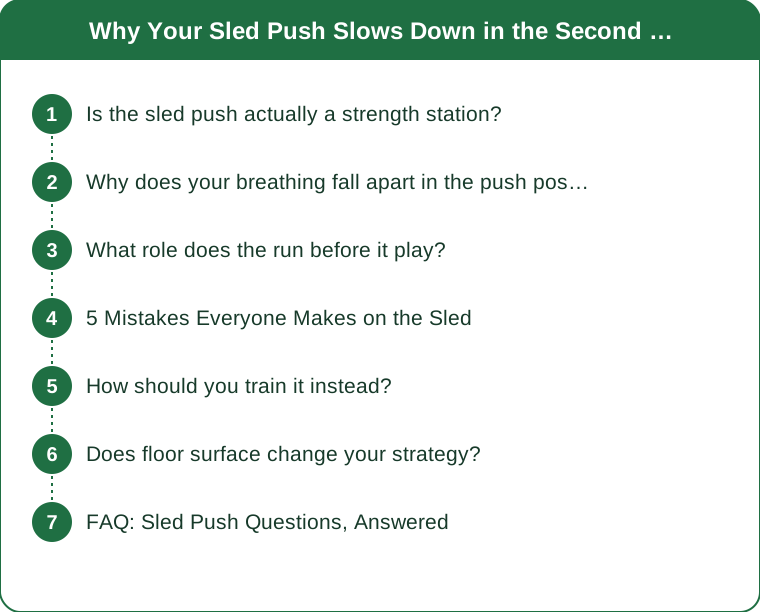
Is the sled push actually a strength station?
Only for the first few metres.
Getting a loaded sled from stationary to moving is a strength problem — you have to overcome static friction, which is meaningfully higher than the friction of keeping it going. Once it is moving, the force requirement drops and stays roughly constant. The rest of the lane is an endurance problem wearing a strength costume.
This matters because it changes what fails. If the station were limited by leg strength, you would fail suddenly and completely, the way a max squat fails. Instead you slow down gradually, which is the signature of a metabolic and postural limit rather than a force limit.
Watch anyone at a race and the pattern repeats: nobody stops because their legs will not push. They stop because they cannot breathe in that position, or because their torso has folded and the angle no longer works.
Why does your breathing fall apart in the push position?
Because the position you need for force is the position that restricts your breathing.
A good push has a long body angle, braced trunk, and arms locked. That brace is an intra-abdominal pressure strategy — you compress against a held breath to keep the torso rigid so leg drive transfers to the sled rather than getting lost in a bending spine.
Held pressure and full breathing are in direct competition. You can brace hard or breathe deeply. Doing both at once is the actual skill of the station, and it is the thing most people never practise.
What happens in the second half is predictable: you accumulate oxygen debt during the first half while barely breathing, then your body forces short shallow breaths, which drops your bracing pressure, which lets your hips rise and your spine round, which lengthens the effective lever and makes the same sled feel heavier.
The chain runs breathing → brace → position → speed. It never runs the other way.
What role does the run before it play?
A larger one than the sled load does.
The push follows a 1 km run, and most people arrive with a heart rate already near threshold. You then enter a station that limits your breathing at exactly the moment you most need it. There is very little margin in that sequence.
The practical consequence: your sled time is largely decided on the run. Coming into the station 10 seconds slower and 15 beats calmer is almost always a net gain, because the push punishes an oxygen deficit more than any other station on the floor.
Athletes who train the run and the sled as separate qualities are consistently surprised on race day. Athletes who train them back to back are not.

5 Mistakes Everyone Makes on the Sled
1. Starting at a sprint. The first two steps should be deliberate and powerful, not fast. Bursting off the line burns the anaerobic capacity you need for the far end of the lane and buys about a second and a half.
2. Standing too upright. A high torso turns the push into an arm and shoulder exercise. You want a long line from heel to head with the hips low enough that leg drive points into the sled, not up into it.
3. Bent arms. Locked elbows make your arms a rigid strut that transmits force. Bent arms make them a muscle group that fatigues, and once your triceps go, the position collapses.
4. Stopping to reset. The single most expensive habit at this station. Restarting means overcoming static friction all over again — you pay the hardest part of the push twice. Slow down to a crawl if you must, but keep it moving.
5. Training only heavy singles. Everyone loads the sled to competition weight and does one lane, then rests four minutes. That trains the wrong system. The third one is where the real adaptation is.
How should you train it instead?
Train the failure mode, not the movement.
Since the limit is repeat-effort capacity under a compromised breathing position, that is what the session should look like:
- Repeated lanes with short rest. Four to six pushes of 20 to 25 metres at race load, resting only the walk back. Time every lane. The metric that matters is the drop-off between your first and last lane, not your fastest single.
- Run-in practice. Do at least one session a week where every push is preceded by 400 to 800 metres at race pace. Push technique that only works fresh is not technique you own.
- Breathing work under brace. Between lanes, practise three-second exhales while maintaining trunk tension. It feels pointless in training and pays on the floor.
- Position holds. 20-second static pushes against an immovable sled or wall, holding the exact race angle. Cheap way to build the postural endurance the second half demands.
Load selection: race weight or slightly below, with high quality. Going heavier than race weight builds the start, which is not the part that is failing.
Does floor surface change your strategy?
Enormously, and it is the biggest reason your gym times do not predict your race times.
Sled friction varies wildly with surface. Turf, rubber, polished concrete and the specific event flooring can differ by 30 percent or more in effective resistance for the same load. Training on slick rubber and racing on turf is a genuinely unpleasant surprise.
If you cannot replicate the surface, replicate the effort. Adjust load until a 25-metre push takes roughly the time you expect on race day, then train at that time rather than that weight.
Also account for the lane. Pushing straight is faster than pushing crooked, and a sled that drifts into a lane marker costs both time and the momentum you have already paid for. Fix your eyes about three metres ahead rather than down at the sled, which keeps your spine long and your line straight.
FAQ: Sled Push Questions, Answered
Should I use small steps or long strides?
Short, frequent, driving steps. Long strides create a moment where neither foot is producing force, and the sled decelerates in that gap. Think of it as a continuous drive rather than a walk.
Is it better to push high or low on the poles?
Low, generally, for a stronger body angle — but only as low as you can hold without your hips rising. If your position breaks down at the low grip in the second half, you are faster at the high grip you can actually maintain.
Why do my forearms burn on a leg station?
Because you are gripping and pulling rather than bracing and pushing. Relax the hands, lock the elbows, and let the skeleton do the transmitting. Forearm burn is a reliable sign your arms have joined a conversation they should not be in.
TL;DR:
- The sled push is a strength problem for three metres and an endurance problem for the other 47.
- Breathing and bracing compete directly; when breathing wins, the brace drops, the hips rise, and the sled gets heavier.
- Your time is largely decided by how you arrive from the run, not by how strong your legs are.
- Train repeated lanes with short rest and measure the drop-off, not the single fastest push.
Change one thing this week: time four consecutive lanes with only the walk back as rest, and write down the gap between the first and the last. That number is the station’s honest scorecard, and it is the one that moves on race day.
Keep Reading
This article is for general informational and styling purposes only. Fit, sizing, and product availability may vary.